"Stranger Things in The Land of Enchantment©"
Lyrics by M. S. McKenzie (Unless Otherwise Noted) | Music Performed by Songs Across America or American Storyteller Music, All Songs Are Protected by ©
~ Associated New Mexico State Links ~
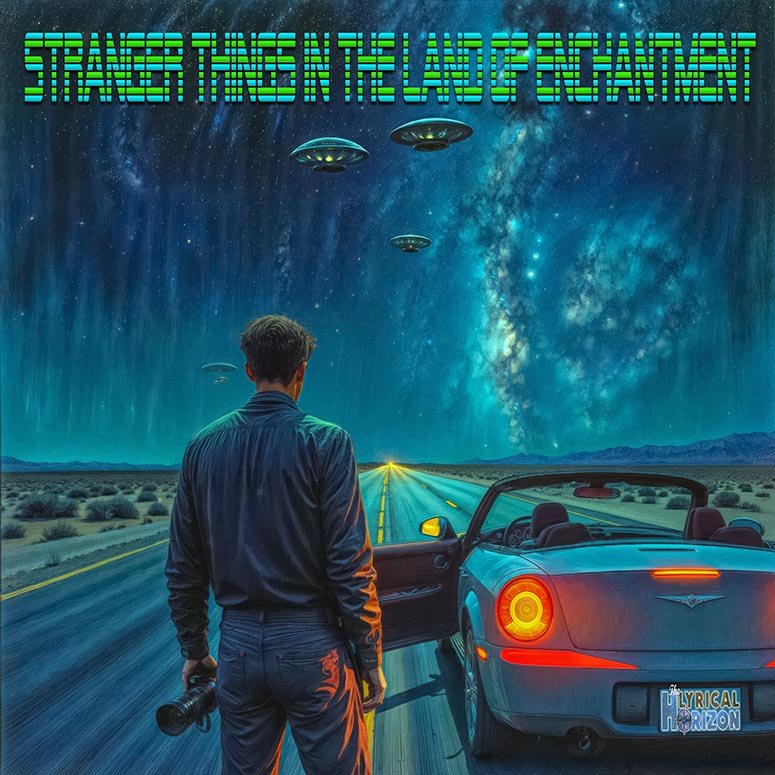
I wrote "Stranger Things in the Land of Enchantment" as a playful road-trip mystery, sending a reporter with a camera and an open mind from Albuquerque down toward Roswell chasing the same 1947 stories everybody already half-believes. I wanted the song to stay genuinely funny for a while, alien souvenir shops, flowing tequila, tongue-in-cheek references to official denials, because the folklore around Roswell has always had one foot in humor.
The story behind the song is the slow shift I built into the second verse, dancing lights among the stars, strange markings on the car, a dashboard clock that simply stops. I wanted the song to earn its title honestly, starting as a curious assignment and ending as something the reporter can no longer explain away as just a story he's covering.
What I care about most is the line about a very thin line, because I wanted the whole song to live in that uncertainty rather than resolve it either way. Songs Across America has room for New Mexico's actual strangeness, the real folklore this stretch of desert has genuinely earned, told with enough humor that the mystery stays fun rather than frightening.
Playful, atmospheric road-trip song built on a catchy, tongue-in-cheek chorus, structured as a journalist's investigative drive from Albuquerque to Roswell and beyond.
New Mexico's UFO folklore and desert mystery, journalistic curiosity turning personal, humor blended with genuine unease, and the pleasure of unresolved uncertainty.
Primary Subject:
A reporter investigating UFO folklore across southeastern New Mexico, from Roswell to White Sands and Truth or Consequences.
Mood:
Playful and curious at the outset, deepening into genuine unease, closing on unresolved mystery.
Some places have earned their own folklore honestly, and the fun of that folklore is in the uncertainty itself, staying playful and unresolved rather than needing to prove or debunk anything.
Stranger Things in The Land of Enchantment
[Verse 1]
I packed a bag in Albuquerque with a camera and map in my hand
Headed east on the 40 to 285 with lots of questions and a plan
The radio hissed and crackled as I crossed the desert floor
Going on about those lights back in '47that were never seen before
Headed down to Roswell, where the truth gets buried all the time
I'm just a reporter chasing aliens with a flash card and an open mind
[Pre-Chorus]
They say that ‘Stranger Things’ happen when you're not looking for signs
Out here beneath the stars and flowing tequila, there's a very thin line
[Chorus]
From the quirky town of Roswell to Truth-or-Consequences
In the Land of Enchantment something strange is always brewing
Alien crafts reported by ranchers then denied by official sources
In southeast New Mexico, you never know what you might be seeing
[Verse 2]
Alien-themed souvenir shops line Roswell’s central strip
I snapped a few pictures then asked the locals for a hot tip
Driving past Alamogordo, I caught dancing lights among the stars
When I pulled into White Sands, I saw strange markings on my car
By the time I got to Las Cruces my hair was standing on end
I noticed the clock on my dashboard stopped as I tried to call a friend
[Pre-Chorus]
They say that ‘Stranger Things’ happen when you're not looking for signs
Out here beneath the stars and flowing tequila, there's a very thin line
[Chorus]
From the quirky town of Roswell to Truth-or-Consequences
In the Land of Enchantment something strange is always brewing
Alien crafts reported by ranchers then denied by official sources
In southeast New Mexico, you never know what you might be seeing
"Stranger Things in the Land of Enchantment" is a playful, atmospheric road-trip song that combines New Mexico travel imagery with UFO folklore, journalistic curiosity, desert mystery, and a growing sense that the narrator may have stumbled into something genuinely unexplained. Beginning in Albuquerque and traveling through Roswell, Alamogordo, White Sands, Las Cruces, and Truth or Consequences, the song follows a reporter who sets out to investigate old stories about strange lights and alien spacecraft, only to experience increasingly unsettling events along the way.
The song balances humor and suspense. Its alien souvenir shops, flowing tequila, malfunctioning dashboard clock, and tongue-in-cheek references to official denials give it a light, adventurous quality. At the same time, the empty highways, crackling radio, dancing lights, mysterious markings, and failed telephone call gradually create the feeling of a classic paranormal thriller. What begins as a curious reporting trip slowly becomes a personal encounter with the unknown.
The title immediately establishes the song's tone. "Stranger Things in the Land of Enchantment" plays on New Mexico's official nickname while suggesting that the state's enchantment may involve more than colorful deserts, mountain sunsets, historic pueblos, and dramatic skies. In this song, enchantment includes rumor, secrecy, strange technology, unexplained lights, lost time, and the possibility that something may be watching from above.
The phrase "Stranger Things" also carries a conversational familiarity. People often use it to describe coincidences or unlikely events, but here the phrase becomes increasingly literal. The narrator enters the desert expecting unusual stories and gradually encounters circumstances that challenge his skepticism.
The first verse opens with a familiar road-trip image. The narrator packs a bag in Albuquerque with a camera and map, presenting himself as prepared, practical, and investigative. The camera represents evidence, while the map represents direction and control. He believes he knows where he is going and what he intends to find.
His route east on Interstate 40 and then south toward U.S. Route 285 leads him toward Roswell and the southeastern New Mexico desert. The specificity of the highways gives the song the feeling of a real journey rather than an abstract tale about aliens. The narrator is moving through recognizable places, which makes the strange events that follow feel more immediate.
The radio begins to hiss and crackle as he crosses the desert floor. This is the first subtle indication that something may be interfering with the ordinary world. Static is a familiar road-trip experience in remote country, but within a UFO story it takes on a more ominous meaning. The lost signal may be nothing more than distance from a transmitter, or it may suggest an unexplained electromagnetic disturbance.
The broadcast discusses the famous reports from 1947, immediately connecting the narrator's trip to the mythology surrounding Roswell. The wording leaves room for skepticism by referring to lights "that were never seen before." The song does not insist upon a single explanation. Instead, it enters the space between eyewitness testimony, government statements, local storytelling, and popular imagination.
"Headed down to Roswell, where the truth gets buried all the time" introduces both humor and suspicion. The line plays on decades of conspiracy theories claiming that evidence was hidden, altered, removed, or explained away. It also works literally, since objects that fall in the desert may disappear beneath sand, dust, and time.
The narrator describes himself as "a reporter chasing aliens with a flash card and an open mind." This line defines his personality. He is curious but not entirely convinced. He wants evidence and approaches the story with professional tools, but he is also willing to consider possibilities outside conventional explanations.
The phrase "flash card" adds an old-fashioned journalistic quality, suggesting notes, questions, or perhaps a camera's memory card. The narrator is not a military investigator or scientist. He is a determined traveler attempting to document whatever he can find.
The pre-chorus introduces the song's central tension between intention and discovery. "Stranger Things happen when you're not looking for signs" suggests that unusual experiences often occur when people are least prepared to interpret them. The narrator is actively searching, yet the real mystery may emerge only when his attention shifts elsewhere.
The stars above the desert establish the ideal setting for such a story. New Mexico's broad skies and sparse population create exceptional darkness in many areas, allowing stars, satellites, aircraft, meteors, and unusual lights to appear with extraordinary clarity.
The mention of tequila adds humor and unreliability. The line between the ordinary and extraordinary becomes "very thin," but so does the line between sober observation and imagination. The song deliberately invites the listener to wonder whether the narrator's experiences are authentic, exaggerated, or influenced by the atmosphere of the trip.
The chorus widens the journey from Roswell to Truth or Consequences, one of the most memorably named towns in the United States. Pairing these two locations gives the song a naturally eccentric geography. Roswell carries associations with UFOs, while Truth or Consequences contributes a name that sounds almost designed for a mystery story.
"In the Land of Enchantment something strange is always brewing" captures the playful heart of the song. New Mexico becomes a place where the unusual seems possible. The state's dramatic terrain, deep cultural history, military installations, scientific research facilities, and vast open spaces provide a convincing background for mysteries that resist easy explanation.
The reference to spacecraft reported by ranchers and denied by official sources summarizes the classic structure of UFO folklore. Ordinary witnesses describe unusual objects, authorities issue alternative explanations, and the disagreement produces decades of speculation.
The chorus avoids declaring either side completely correct. The word "reported" acknowledges testimony, while "denied" acknowledges official rejection. The narrator remains between these positions, searching for evidence but increasingly aware that certainty may be impossible.
"In southeast New Mexico, you never know what you might be seeing" is an effective concluding line because it captures both genuine uncertainty and playful paranoia. A distant light might be an aircraft, satellite, meteor, military exercise, optical effect, or something less familiar. The ambiguity is the point.
The second verse begins with Roswell's modern identity as a destination built partly around alien tourism. Souvenir shops line the central strip, turning one of America's most famous conspiracy stories into local culture, entertainment, and commerce.
The narrator photographs the displays but continues seeking a "hot tip." This keeps his journalistic mission moving forward. He enjoys the quirky attractions, yet he wants something more substantial than plastic aliens, themed signs, and novelty merchandise.
As he drives past Alamogordo, the story begins shifting from humorous investigation into personal experience. Dancing lights appear among the stars. The word "dancing" suggests movement too irregular or graceful to dismiss immediately as ordinary aircraft.
Alamogordo also contributes an atmosphere of scientific and military history. Even without directly naming particular facilities or experiments, the location evokes desert testing grounds, aerospace activity, and technological secrecy. This makes the unexplained lights feel plausible within the song's fictional world.
White Sands intensifies the visual strangeness. Its vast pale dunes already resemble an otherworldly landscape, especially beneath moonlight or a star-filled sky. When the narrator discovers strange markings on his car, the mystery becomes physical and personal.
The markings suggest that something approached the vehicle while he was distracted or asleep. They might be scratches, symbols, residue, or impressions left by an unknown source. The song wisely leaves their exact appearance unexplained, allowing the listener to imagine something more disturbing than a detailed description might provide.
By the time the narrator reaches Las Cruces, his confidence has begun to unravel. His hair standing on end may indicate fear, static electricity, or some electromagnetic presence. The phrase works both as a familiar expression of terror and a possible physical symptom of the strange conditions around him.
The stopped dashboard clock introduces the classic paranormal motif of missing or altered time. A clock that suddenly freezes suggests interference with the vehicle, an electrical malfunction, or an event outside normal experience. It also undermines the narrator's ability to reconstruct what happened.
His attempt to call a friend fails at precisely the moment he most needs confirmation and connection. The failed call isolates him within the desert. Earlier, he was an amused reporter chasing a story. Now he is alone, uncertain, and unable to tell anyone what he has seen.
The second pre-chorus takes on a darker meaning than the first. The same words are repeated, but the narrator is no longer speculating casually. He has now encountered lights, markings, electrical irregularities, and lost communication. The "thin line" is no longer merely between fact and folklore. It is between the world he understands and something he cannot explain.
The repeated chorus likewise changes through context. During its first appearance, it sounds like a playful travel summary. After the events at White Sands and Las Cruces, it becomes a warning. The statement that "you never know what you might be seeing" now reflects lived uncertainty rather than tourist curiosity.
Structurally, the song has the feeling of an unfinished investigation, which suits its subject well. The absence of a final explanation allows the mystery to remain open. The narrator has gathered observations but not enough evidence to reach a conclusion.
A future third verse could continue toward Truth or Consequences, perhaps involving a roadside motel, an unusual witness, missing photographs, or the discovery that the markings on the car match something reported in 1947. However, the existing two-verse version also works effectively as a compact paranormal road story that ends while the narrator is still traveling.
Musically, "Stranger Things in the Land of Enchantment" would work well as desert rock, Southwestern Americana, country-rock, or a lightly cinematic pop-rock song. It should feel adventurous and slightly eccentric rather than frightening in a purely horror-oriented way.
The introduction could begin with acoustic guitar, tremolo electric guitar, low bass, and a distant radio-static effect. A dry snare, subtle shaker, or brushed percussion could evoke tires moving steadily along an empty desert highway.
The verses would benefit from a conversational vocal delivery, allowing the narrator's personality to carry the story. He should sound confident and amused at first, with increasing uncertainty entering his voice as the events become harder to explain.
The pre-chorus could introduce a minor-key shift or suspended chords, signaling that the ordinary road trip is entering stranger territory. Atmospheric electric guitar, synthesizer, or theremin-like tones could appear subtly without turning the arrangement into parody.
The chorus should be catchy, broad, and slightly theatrical. Harmony vocals on "Land of Enchantment" and "something strange is always brewing" could reinforce the song's playful mystery. The rhythm should remain propulsive, preserving the feeling of a long highway journey.
The second verse could introduce more electronic textures as the narrator encounters dancing lights and a stopped clock. Brief glitches, reversed guitar sounds, or radio interference could suggest technological disruption while remaining integrated into the musical arrangement.
A future instrumental break could combine Southwestern guitar with science-fiction textures. Slide guitar, harmonica, tremolo effects, and low synthesizer tones would create a distinctive mixture of desert Americana and UFO cinema.
At its heart, "Stranger Things in the Land of Enchantment" is a song about the pleasure of uncertainty. It does not attempt to prove that alien spacecraft visited New Mexico, nor does it dismiss everyone who reports unusual experiences. Instead, it celebrates the imaginative space created when familiar explanations seem incomplete.
The song also works as a lively New Mexico travelogue. Albuquerque, Roswell, Alamogordo, White Sands, Las Cruces, and Truth or Consequences give it a strong sense of place. Each location contributes something different: departure, legend, science, surreal landscape, growing unease, and eccentric destination.
Most importantly, the narrator changes during the journey. He begins as a reporter searching for a colorful story and gradually becomes part of one. His camera, map, questions, and professional curiosity cannot fully protect him from the possibility that some mysteries resist documentation.
"Stranger Things in the Land of Enchantment" is therefore both a humorous alien-themed road song and an atmospheric mystery. It invites the listener into a desert world where radios crackle, lights move strangely, clocks stop, official stories conflict, and the open sky always seems to be hiding one more unanswered question.









.jpg)