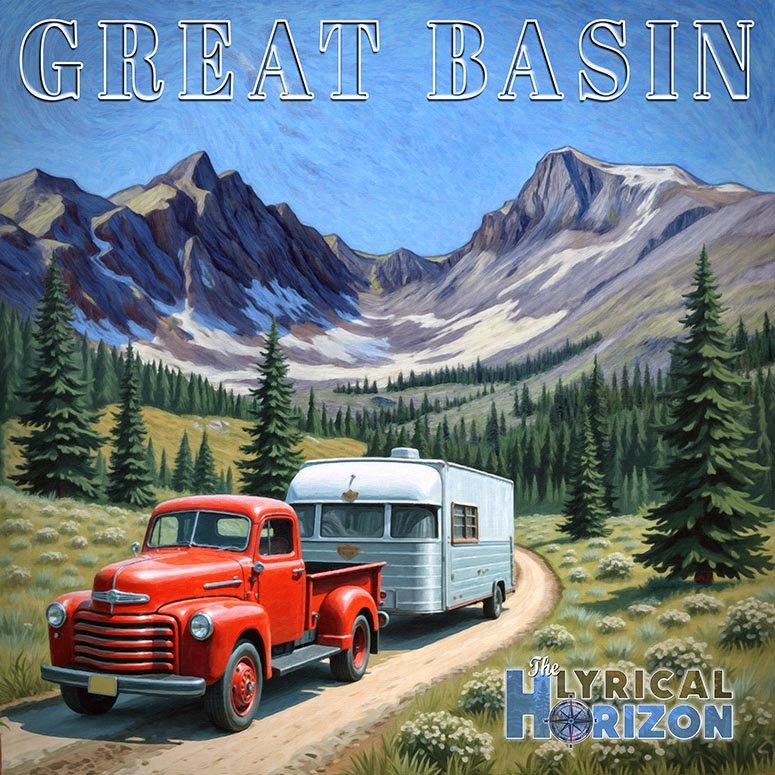
"Great Basin©"
Lyrics by M. S. McKenzie (Unless Otherwise Noted) | Music Performed by Songs Across America or American Storyteller Music, All Songs Are Protected by Copyright
~ Associated Nevada State Links ~
"Great Basin"
I wrote "Great Basin" for the specific kind of silence you only find in one of the least-visited national parks in the country. Limestone corridors beneath my feet, Lehman's chambers so dark and deep, opens the song underground on purpose, because I wanted the caves themselves, patient, ancient, largely unseen, to set the tone for everything that follows above them.
The story behind the song is the pairing I built the chorus around, dark skies where stars are free to roam sitting right alongside Wheeler's shadow over bristlecone grace. Great Basin protects some of the oldest living trees on Earth and some of the darkest skies left in the country, and I wanted both of those quiet superlatives held together rather than treated as separate attractions.
What I care about most is the phrase in this place, isolation breeds resilience, and beauty thrives in reverent silence, because I think that's the actual argument of the whole park. Songs Across America has plenty of songs about dramatic, crowded wonders. This one is for the wonder that survives specifically because almost nobody comes to see it, patient and largely undisturbed.
Hushed, atmospheric folk built on sparse acoustic textures and a reverent, wide-open chorus, structured as a journey from underground caverns up to the desert night sky.
The overlooked grandeur of Great Basin National Park, ancient bristlecone pines and dark night skies, isolation as a source of resilience, and beauty that thrives in silence.
Primary Subject:
Great Basin National Park in Nevada, its Lehman Caves, bristlecone pines, Wheeler Peak, and dark night skies.
Mood:
Hushed, reverent, and quietly resilient throughout.
Some of the most remarkable beauty survives precisely because it goes unnoticed, thriving in isolation and reverent silence rather than under crowds and attention, and that quiet resilience deserves its own kind of reverence.
[Intro: Instrumental]
[Verse 1:]
Limestone corridors beneath my feet
Lehman's chambers so dark and deep
Where water carved its patient tale
In cavernous rooms beyond the veil
Lonely echoes of ages passed
In this desert fortress vast
[Chorus:]
Great Basin calls the Nevadan home
Under dark skies, stars are free to roam
Wheeler's shadow over bristlecone grace
Time moves differently in this sacred place
Where Nevada keeps her wild heart beating
And the hand of nature keeps on creating
[Verse 2:]
From Mather's edge the world unfolds
Sagebrush valleys lead to sunset gold
The desert stretches out like the sea
A deafening silence spreads beneath me
In this place, isolation breeds resilience
And beauty thrives in reverent silence
[Chorus:]
Great Basin calls the Nevadan home
Under dark skies, stars are free to roam
Wheeler's shadow over bristlecone grace
Time moves differently in this sacred place
Where Nevada keeps her wild heart beating
And the hand of nature keeps on creating
[Verse 3:]
Lexington arch stands tall and stark
From mountain's spine, it’s left its mark
Just wind and rain and thousands of years
Carving sandstone away until its cleared
Perhaps a window to the world beyond
Where the ancient ones still live on
[Bridge:]
This is where the soul can breathe
And what you seek is what you leave
Far from cities, crowds, and craze
In this wild and lonely place
[Verse 4:]
Bristlecone pines create twisted hands
For millennia they've watched these lands
Mountain peaks stand as silent sentinels
Guarding a land that’s so unforgettable
I’m but a witness to the beauty of this place
Such sweet surrender in this hallowed space
[Chorus:]
Great Basin calls the Nevadan home
Under dark skies, stars are free to roam
Wheeler's shadow over bristlecone grace
Time moves differently in this sacred place
Where Nevada keeps her wild heart beating
And the hand of nature keeps on creating
[Outro: Instrumental]
"Great Basin" is a spacious, meditative tribute to Great Basin National Park and the isolated mountain-and-desert landscapes of eastern Nevada. Moving from the underground chambers of Lehman Caves to high overlooks, natural arches, ancient bristlecone pines, Wheeler Peak, and exceptionally dark night skies, the song portrays the park as a place where geological time, solitude, endurance, and natural creativity can be felt with unusual intensity.
Unlike songs built around dramatic action or crowded attractions, "Great Basin" draws much of its power from silence. The landscape is vast, remote, and frequently overlooked, yet that isolation is precisely what gives it meaning. The song suggests that visitors who step away from cities, noise, schedules, and constant stimulation may discover a different way of experiencing both the natural world and themselves.
The title's simplicity is appropriate. "Great Basin" does not need an elaborate subtitle or metaphor because the name already evokes scale, distance, and mystery. It refers not only to the national park but to the larger basin-and-range country of the American West, where mountain ranges rise like islands above broad valleys and much of the water drains inward rather than reaching the ocean.
Within the song, however, Great Basin becomes more than a geographical designation. It is a state of mind, a place in which the narrator encounters darkness without fear, silence without emptiness, and solitude without loneliness.
The instrumental introduction should establish that sense of space before the first lyric arrives. Fingerpicked acoustic guitar, soft piano, low strings, or a sustained atmospheric keyboard could create the impression of entering a landscape far removed from ordinary life. The arrangement should not feel hurried. Silence between notes would be as important as the notes themselves.
The first verse begins underground in Lehman Caves. This is an effective opening because it introduces Great Basin from the inside out. Rather than beginning with distant mountains or desert horizons, the song first enters limestone chambers hidden beneath the surface.
"Limestone corridors beneath my feet" creates the sensation of descending into a concealed world. The word "corridors" gives the caves an architectural quality, as though water and minerals have constructed a vast underground palace over immense stretches of time.
Lehman's chambers are described as "dark and deep," emphasizing both their physical depth and their psychological effect. Entering a cave requires leaving behind familiar light, open sky, and visible distance. The visitor becomes dependent upon guided illumination and must confront an environment shaped almost entirely beyond human awareness.
The line "Where water carved its patient tale" expresses one of the song's central ideas. Nature creates through persistence rather than haste. Drop by drop, mineral-rich water forms passages, flowstone, stalactites, stalagmites, shields, and other cave features.The word "patient" gives geological time a personality. Water does not force the cave into existence. It works continuously and almost invisibly, allowing thousands or millions of small actions to accumulate into something monumental.The "cavernous rooms beyond the veil" suggest that the underground world is normally hidden from human sight. The veil may be the earth itself, the darkness of the cave, or the boundary between ordinary time and deep time.
The lonely echoes of ages past reinforce the sense that these chambers have existed through countless human generations. Footsteps and voices temporarily disturb the silence, but when visitors leave, the cave returns to its ancient stillness.Calling the region a "desert fortress" connects the underground cave with the severe landscape above it. Great Basin appears protected by distance, mountains, dryness, darkness, and difficult terrain. It is not inaccessible, but it does not reveal itself as easily as more heavily visited destinations.
The first chorus rises from the subterranean world into the open sky. "Great Basin calls the Nevadan home" gives the park a regional identity and suggests that it represents something essential about Nevada beyond casinos, cities, and popular stereotypes.The phrase may also describe a spiritual homecoming. Even visitors who do not live in Nevada may feel that the landscape calls them back toward something fundamental: quiet, patience, resilience, darkness, and open space.
"Under dark skies, stars are free to roam" is one of the chorus's most evocative images. In places without heavy artificial light, stars appear more numerous, brighter, and more spatially complex. They do not literally move more freely, but the absence of urban glow allows the sky to recover its full scale.The line also connects darkness with freedom. Modern society often treats darkness as something to eliminate, yet here it becomes a natural resource. The night sky flourishes because artificial light no longer overwhelms it.
"Wheeler's shadow over bristlecone grace" brings the park's highest mountain together with some of its oldest living trees. Wheeler Peak represents elevation and physical grandeur, while the bristlecone pines represent endurance through time.The word "grace" is particularly appropriate for the bristlecones. Their twisted forms are not conventionally symmetrical or youthful, yet their beauty comes from survival. Wind, cold, drought, poor soil, and exposure have shaped them into living records of hardship."Time moves differently in this sacred place" identifies the chorus's emotional center. Human schedules, deadlines, and anxieties feel less absolute when placed beside caves formed through geological processes, trees that have lived for millennia, and stars whose light has traveled vast distances.
The word "sacred" need not imply a specific religious belief. It describes a place deserving reverence because it creates humility, perspective, and awareness of life beyond individual concerns.The final chorus lines present Nevada's wild heart as still beating. This suggests that beneath the state's highways, mines, cities, and entertainment culture, an older and less altered Nevada remains alive."The hand of nature keeps on creating" emphasizes that Great Basin is not a completed monument. Water continues moving through rock, frost breaks mountain surfaces, wind reshapes exposed land, plants grow, trees endure, and erosion gradually alters the landscape.
The second verse climbs to Mather Overlook, where the scale of the surrounding basin-and-range country becomes visible. From this elevated viewpoint, sagebrush valleys, distant mountains, and broad desert expanses unfold below.The world "unfolds" as though it were being opened like a map or book. The visitor can see the relationship between mountain slopes, valleys, desert vegetation, and the enormous distances separating different features.
Sagebrush valleys leading toward sunset gold bring warmth into the otherwise austere setting. Sagebrush is modest compared with towering trees or colorful wildflowers, but it defines much of the interior West. Its muted colors, fragrance, and endurance belong naturally to the Great Basin landscape.The comparison of the desert to the sea is especially effective. From a high viewpoint, the valley may appear to extend like a broad, open ocean, with mountain ranges rising like islands on the horizon.
This metaphor also conveys the desert's scale and emotional effect. A sea and a desert can both make an individual feel small, exposed, and aware of distance."A deafening silence spreads beneath me" uses contradiction to describe the intensity of true quiet. Silence becomes so complete that it feels almost physical. Without traffic, aircraft, conversation, machinery, or electronic noise, the listener becomes newly aware of wind, breath, heartbeat, and small natural sounds.
The phrase "isolation breeds resilience" connects the landscape with the life it supports. Plants and animals living in the Great Basin must endure limited water, temperature extremes, high elevation, strong winds, and long distances between hospitable environments.Isolation also shapes human experience. People who live or travel in remote country often develop self-reliance, patience, awareness, and respect for conditions beyond their control.
"Beauty thrives in reverent silence" argues that the landscape does not require spectacle to become meaningful. Great Basin's beauty emerges slowly through attention. It can be found in the shape of a distant ridge, the scent of sagebrush, the texture of limestone, the movement of starlight, or the twisted grain of an ancient tree.The second chorus returns with a deeper understanding of the park's call. After the high desert overlook, the words about dark skies and altered time feel less abstract. The narrator has begun to experience the landscape's scale directly.
The third verse travels to Lexington Arch, one of the park region's most unusual geological formations. Its tall, stark form appears almost like an opening carved intentionally into the mountainside.The arch "stands tall and stark," emphasizing its isolation and unusual shape. Unlike the crowded arches of more famous parks, Lexington Arch exists within a quieter and less frequently visited setting.The line "From mountain's spine, it's left its mark" suggests that the arch is part of the mountain's structure while also interrupting it. The opening creates negative space within solid rock, allowing sky and distant landscape to become part of the formation.
Wind, rain, and thousands of years are credited with carving the stone. Once again, the song emphasizes patient natural processes. The arch is not the product of one dramatic event but of weathering and erosion working across a timescale difficult to imagine.The phrase "until it's cleared" appears to mean that the opening was gradually cleared through the rock. A smoother grammatical version might be:
"Carving stone until the arch appeared"
or:
"Carving through until the opening cleared."
The first option is especially natural and maintains the lyric's meaning."Perhaps a window to the world beyond" gives the arch symbolic significance. Physically, it frames the landscape on the other side. Emotionally, it may represent a doorway between present and past, known and unknown, material and spiritual experience.The line "Where the ancient ones still live on" can refer broadly to memories, earlier peoples, ancestral presence, and the enduring forces that shaped the land. It gives the arch a sense of continuity without requiring the song to define exactly what lies "beyond."
The bridge turns from landscape description toward personal release. "This is where the soul can breathe" presents the park as an antidote to confinement. The open spaces and quiet environment allow the narrator to feel less psychologically crowded.The line "And what you seek is what you leave" is intriguing and open to interpretation. It may suggest that people arrive seeking peace but find it only by leaving behind anxiety, ego, noise, regret, or the need for answers.It can also mean that the object of the search is not something acquired and carried away. The experience teaches release rather than possession. The visitor receives clarity by surrendering burdens.
"Far from cities, crowds, and craze" identifies what has been temporarily removed. The word "craze" conveys both frantic activity and collective obsession. The park offers distance from the pressures that make constant urgency seem normal."In this wild and lonely place" reframes loneliness as something potentially restorative. The landscape is lonely because it is sparsely inhabited and physically remote, but that loneliness creates the space necessary for self-examination.
The fourth verse reaches the ancient bristlecone pines, the song's most powerful symbols of endurance. Their limbs resemble twisted hands shaped by wind, ice, sun, and centuries of exposure."Bristlecone pines create twisted hands" personifies the trees as witnesses reaching outward from deep time. Their contorted forms record the difficulty of survival at high elevation.
"For millennia they've watched these lands" places the narrator's brief visit in humbling perspective. Human lives, governments, cities, and historical periods have risen and passed during the lifespan of individual trees.
The bristlecones do not merely survive despite harsh conditions. In a sense, those conditions contribute to their longevity. Slow growth, dense wood, dry climate, and difficult terrain allow them to persist where faster-growing species may struggle.
The mountain peaks then become "silent sentinels," continuing the song's imagery of guardianship. They stand above valleys, caves, ancient trees, and desert expanses, appearing to watch over the park.Calling the land unforgettable may seem simple, but within the song it refers to more than scenic beauty. The park becomes unforgettable because it changes the visitor's perception of time, silence, age, and personal importance."I'm but a witness to the beauty of this place" expresses humility. The narrator does not claim ownership or mastery. He is present only briefly, observing something that existed long before him and will likely remain long after he is gone.
"Such sweet surrender in this hallowed space" completes the narrator's emotional journey. Surrender is not defeat. It is the release of the need to control, possess, explain, or hurry.The word "sweet" indicates relief. The narrator finds freedom by accepting his small place within a much larger natural order.The final chorus now functions as both tribute and testimony. The narrator has entered caves, crossed overlooks, considered ancient arches, and stood among bristlecone pines. The park's call is no longer merely heard. It has been answered.
The dark skies, Wheeler Peak, and bristlecone groves become a single image of space and time. Stars represent cosmic distance, the mountain represents geological scale, and the trees represent living endurance.The final line, "the hand of nature keeps on creating," leaves the song open-ended. The park's story continues after the music stops. Rock continues weathering, trees continue growing, stars cross the night sky, and water continues shaping hidden chambers.Musically, "Great Basin" would work beautifully as a slow cinematic Americana, atmospheric folk-rock, or orchestral acoustic ballad. It should feel spacious and reverent, with gradual development rather than dramatic rhythmic changes.
The instrumental introduction could begin with acoustic guitar or piano, joined by a low cello and distant violin. Subtle cave-like reverberation might be used during the opening verse to suggest the enclosed space of Lehman Caves.The verses should retain an intimate vocal delivery. The singer should sound observant and humbled, as though describing discoveries made in real time.
The first chorus could widen gently through strings, harmony vocals, and a restrained drum pattern. The layered instrumentation should create elevation without breaking the song's quiet character.The second verse might introduce a broader acoustic sound to reflect the high overlook and open desert. A sustained electric guitar or violin line could suggest the long horizon.The third verse could become slightly mysterious, using minor chords or sparse piano beneath the image of Lexington Arch as a window to another world.The bridge should be reduced to its simplest form, perhaps voice, piano, and one sustained string line. This would create the feeling that the landscape has removed everything unnecessary.
The fourth verse could gradually rebuild around the bristlecone imagery. Low strings, warm harmony vocals, and a slow percussion rise would emphasize the emotional weight of the ancient trees.The final chorus should be the fullest section, but it should remain graceful rather than bombastic. Layered voices on "Great Basin calls" could make the park's call sound communal and timeless.The instrumental outro might feature a violin or acoustic guitar melody slowly fading into silence. A faint wind-like texture or distant night ambience could remain after the final chord, returning the listener to the park's defining quiet.
At its heart, "Great Basin" is a song about learning to experience time differently. Modern life encourages speed, productivity, noise, and constant attention, while the park reveals a world shaped through slowness.Water forms caves one drop at a time. Wind and rain carve openings through stone. Bristlecone pines grow almost imperceptibly across thousands of years. Mountains erode, stars move, and ecosystems adapt without reference to human schedules.The song also expands the meaning of Nevada. It presents the state not only as a place of cities, gambling, mining, or desert highways, but as a land of alpine peaks, underground caverns, ancient forests, extraordinary night skies, and profound solitude.
Most importantly, the narrator does not leave Great Basin with a trophy or a simple answer. He leaves with humility, release, and the awareness that being a witness can be enough."Great Basin" is therefore both a national park tribute and a quiet meditation on endurance. It celebrates a landscape where apparent emptiness contains immense complexity, darkness reveals hidden brilliance, and isolation creates the conditions for resilience.Its final message is that some places do not ask to be conquered, consumed, or hurried through. They ask only that we become still enough to notice them. In Great Basin, the narrator discovers that surrendering to silence is not losing oneself. It is a way of returning to what matters.










.jpg)