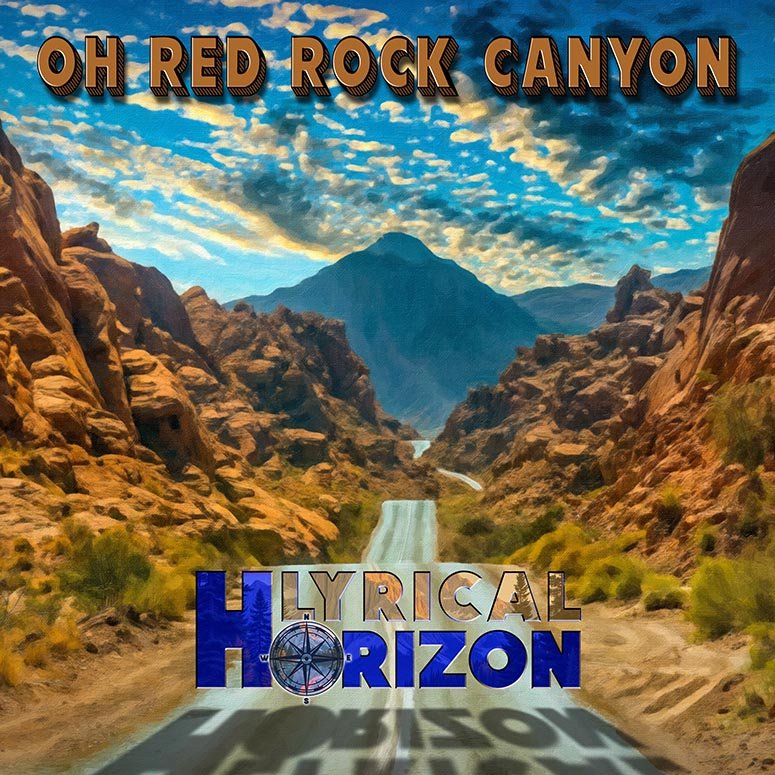
"Oh Red Rock Canyon©"
Lyrics by M. S. McKenzie (Unless Otherwise Noted) | Music Performed by Songs Across America or American Storyteller Music, All Songs Are Protected by ©
~ Associated Nevada State Links ~
"Oh Red Rock Canyon"
I wrote "Oh Red Rock Canyon" for the specific relief of finding real wilderness a short drive from the Las Vegas Strip, where bright city lights fade far from view. Dawn breaks over high sandstone towers, where crimson walls catch first light, and I wanted the song to feel like the exact moment a person leaves the noise behind and the desert's own quiet takes over instead.
The story behind the song is how much layered time I let the canyon carry, an ancient ocean that once flowed through the Calico Hills, petroglyphs whispering from people long since gone, climbers now testing the same sandstone with modern gear. I wanted the canyon to feel like it's holding every era of its own history simultaneously, geologic, ancient human, and present-day, rather than treating any one of them as more important.
What I care about most is the chorus's claim, calling out to many a restless soul, where every trail leads to wonder, and every heart feels whole, because I wanted Red Rock Canyon to be understood as genuine refuge rather than just a scenic detour. Songs Across America has plenty of songs about places you have to travel far to find. This one is for the wilderness sitting improbably close to one of the loudest cities in the country.
Warm, reverent desert folk-rock built on layered vocals and a wide, welcoming chorus, structured as a dawn walk through Red Rock's sandstone towers and hidden petroglyphs.
Wilderness found close to urban noise, layered geologic and human history in the same canyon, restlessness answered by quiet refuge, and reverence for ancient stone and petroglyph.
Primary Subject:
Red Rock Canyon National Conservation Area outside Las Vegas, its sandstone cliffs, Calico Hills, and ancient petroglyphs.
Mood:
Peaceful, reverent, and quietly restorative throughout.
Real refuge doesn't always require traveling far. Sometimes it's sitting improbably close to the loudest places we live, carrying millions of years of history in quiet crimson stone, waiting for someone restless enough to find it.
[Intro: Instrumental]
[Verse 1]
Dawn breaks over high sandstone towers
Where crimson walls catch first light
And limestone tells its ancient story
While the Mojave silence holds it tight
These cliffs have watched millennia pass
Where climbers test their feet and hands
In the shadows where rattlesnakes hide
From birds of prey that scan these lands
[Chorus: Layered Voices]
Red Rock rises up from the desert floor
A subtle canvas painted in rock and sand
Where bright city lights fade far from view
And the wild things still make their stand
Oh Red Rock Canyon...
...Oh Red Rock Canyon
Calling out to many a restless soul
Where every trail leads to wonder
And every heart feels whole
[Verse 2]
Calico Hills with their wave-like rows
Burst from the earth in rust-colored rings
Where once an ancient ocean flowed
Now the climbers' carabiners sing
Petroglyphs whisper a deep mystery
From people who have long since gone
While a desert tortoise moves slowly
Through the cool of a primeval dawn
[Instrumental Break]
[Verse 3]
Slot canyons carved by floods and quakes
Where juniper roots are anchored in stone
Rainbow-colored Aztec sandstone bakes
And tells of habitats that have come and gone
This paradise isn't far from casino lights
As the crow flies it's just thirteen miles away
But here a different kind of jackpot waits
For those who choose a gentler way
[Verse 4]
Seasonal waterfalls carve deep paths
Through limestone walls and through time
Hikers trace the outline of Wilson Cliffs
Where peregrine falcons make their climb
The Keystone Thrust fault trail
Hikers to witness forces from deep below
A sanctuary of solitude and peace abides
Where only hearty cactuses grow
[Chorus: Layered Voices]
Red Rock rises up from the desert floor
A subtle canvas painted in rock and sand
Where bright city lights fade far from view
And the wild things still make their stand
Oh Red Rock Canyon...
...Oh Red Rock Canyon
Calling out to many a restless soul
Where every trail leads to wonder
And every heart feels whole
[Outro: Instrumental]
"Oh Red Rock Canyon" is a sweeping Southwestern folk-rock song about the extraordinary wilderness rising just beyond the lights and spectacle of Las Vegas. Through images of crimson cliffs, ancient seabeds, desert wildlife, petroglyphs, climbers, seasonal waterfalls, and powerful geological forces, the song presents Red Rock Canyon as a place of wonder, solitude, and renewal.
The song's central contrast is between two very different kinds of Nevada experience. Only a short distance from casinos, hotels, neon signs, and crowded entertainment districts lies a landscape shaped by wind, water, faulting, erosion, and immense stretches of geological time. Las Vegas offers excitement through human invention, while Red Rock Canyon offers a quieter and more enduring form of richness.
The title has the warm, direct quality of an invocation. The repeated phrase "Oh Red Rock Canyon" sounds like both a greeting and an expression of gratitude. It suggests that the narrator is not simply describing the canyon but responding emotionally to it, as though the landscape itself were calling out to travelers who need distance from noise, pressure, or restlessness.The instrumental introduction could establish an open desert atmosphere before the first words arrive. Fingerpicked acoustic guitar, warm electric guitar, low percussion, and a sustained violin or pedal-steel line could evoke dawn slowly spreading across the Mojave. The arrangement should feel spacious, allowing silence to become part of the musical landscape.
The first verse begins at sunrise, when Red Rock's sandstone formations catch the first light. Dawn is an especially effective opening image because it reveals the cliffs gradually. Their colors shift from shadowed brown and purple into red, orange, gold, and pale cream as sunlight reaches the canyon walls.The "high sandstone towers" establish the scale of the landscape, while the crimson walls create its defining visual identity. These formations appear almost architectural, like enormous natural monuments rising above the desert floor.
The line "limestone tells its ancient story" introduces the canyon's geological depth. Red Rock Canyon contains evidence of environments that existed long before the modern Mojave Desert. Limestone layers preserve the memory of ancient marine conditions, while younger sandstone formations reveal later periods dominated by sand dunes and desert environments.This contrast between sandstone and limestone makes the landscape feel like an exposed history book. Different rocks record different worlds, each separated by spans of time far beyond ordinary human experience.
The Mojave silence "holds it tight," suggesting that these ancient stories remain contained within the cliffs. The rocks do not speak in words, but their layers, colors, fractures, and fossils communicate a history to anyone willing to look closely.The next lines move from geology into human activity and wildlife. Climbers test their hands and feet against the canyon walls, placing modern adventure within a landscape that has existed for millions of years. Their movements are temporary and small compared with the towers they climb.
The rattlesnake hiding in shadow and the birds of prey scanning from above introduce the constant relationship between predator, shelter, heat, and survival. The desert may appear still, but life is always moving through it.The rattlesnake seeks protection from sunlight and danger, while hawks and other raptors search the ground from above. The scene reminds the listener that wilderness is not a passive backdrop. It is a functioning ecosystem in which every creature has adapted to harsh conditions.The chorus opens outward with the image of Red Rock rising from the desert floor. This upward movement gives the landscape a powerful presence and provides the song with a natural melodic lift.Calling the canyon "a subtle canvas painted in rock and sand" is particularly effective because its beauty differs from the deliberate spectacle of Las Vegas. Red Rock does not flash, advertise, or demand attention. Its colors change with light, season, weather, and distance.
The word "subtle" also encourages the listener to slow down. The landscape reveals itself through variations in stone, desert plants, shadows, tracks, cliffs, and open sky. Its beauty becomes greater through observation rather than immediate sensory overload.The line "Where bright city lights fade far from view" establishes the emotional threshold between city and wilderness. Even though Las Vegas is geographically close, entering Red Rock Canyon can make the city feel much farther away.
The fading lights symbolize more than physical distance. They represent the temporary disappearance of distraction, commercial pressure, nightlife, traffic, and artificial stimulation. In their absence, the visitor becomes more aware of wind, sunlight, stone, wildlife, and personal thought."The wild things still make their stand" presents the canyon as a refuge. Desert tortoises, rattlesnakes, peregrine falcons, small mammals, reptiles, and hardy plants continue living within a region increasingly surrounded by urban development.
The phrase "make their stand" also gives the chorus a conservation dimension. The survival of wild places cannot be assumed. Red Rock exists beside one of the country's fastest-changing metropolitan landscapes, making protection of habitat, water, viewsheds, and solitude especially meaningful.The repeated title phrase allows layered voices to transform the chorus into something almost communal. Rather than one traveler expressing admiration, several voices seem to answer the canyon's call.
"Calling out to many a restless soul" identifies the kind of person who may be most affected by this place. The canyon draws people who feel confined, overwhelmed, dissatisfied, or disconnected. They may arrive seeking exercise or scenery but discover a deeper emotional release."Where every trail leads to wonder" does not mean that every route produces the same experience. Some lead toward cliffs, others toward springs, canyons, overlooks, petroglyphs, or geological formations. Yet each offers some encounter with beauty, effort, discovery, or perspective.The final line, "And every heart feels whole," presents the canyon as restorative. It does not claim that wilderness permanently solves every problem. Instead, it suggests that time spent in a place of scale, silence, and natural order can briefly restore a sense of internal balance.
The second verse enters the Calico Hills, among the most recognizable formations in Red Rock Canyon. Their curved and layered sandstone creates a wave-like appearance, as though the earth has been folded, lifted, and frozen in motion.The "rust-colored rings" emphasize the bands of iron-rich red and orange that give the hills their dramatic appearance. These formations seem almost fluid despite being made of stone.
The reference to an ancient ocean broadens the geological story. The modern desert is not a permanent condition but one stage in a much longer sequence of changing environments. The presence of marine limestone in the region reminds the listener that water once occupied landscapes now dominated by heat and stone.The sound of climbers' carabiners introduces a bright metallic detail. It is a modern sound echoing through ancient formations. The ringing gear gives the cliffs a kind of accidental music while reinforcing Red Rock's international reputation as a climbing destination.The petroglyphs add a human timescale older than modern recreation. Their presence indicates that people traveled through, lived within, and interpreted this desert long before roads, scenic drives, visitor centers, and climbing routes existed.
"Petroglyphs whisper a deep mystery" respects the fact that their full meanings may not be available to modern viewers. They are not simply decorations. They are cultural records connected to people, places, stories, ceremonies, journeys, and ways of understanding the desert.The phrase "people who have long since gone" creates a feeling of absence, although Indigenous connections to the broader region have not disappeared. The image works most effectively as a reference to the original makers of particular carvings rather than suggesting that Native peoples themselves vanished entirely.
The desert tortoise slows the pace of the verse. Its deliberate movement contrasts with the climbers above and the rapid movement of modern visitors through the scenic drive.The tortoise is one of the Mojave's most recognizable survivors. Its ability to endure heat, drought, and scarce resources reflects the extraordinary adaptations required for desert life.Placing it in the cool of dawn is ecologically and poetically fitting. Before daytime heat intensifies, the desert briefly becomes gentler, and animals can move with less exposure.
The instrumental break offers a chance to let the landscape speak without narration. A violin, electric guitar, Native-style flute used respectfully, or resonant acoustic guitar could carry a melody that rises and falls like the sandstone formations.The break might also include subtle sounds resembling climbing gear, wind, or distant birds, though these should remain understated. The purpose is to create space rather than fill every moment.
The third verse enters narrower and more dramatic terrain. Slot canyons carved by floods represent the sudden power of desert water. A canyon may remain dry and quiet for long periods, yet a distant storm can send violent water through confined rock passages.The lyric also mentions earthquakes, acknowledging that faulting and tectonic movement contributed to the broader structure of the region. Water carves the finer details, while deeper geological forces uplift, fracture, and reposition the rock.Juniper roots anchored in stone offer a strong image of persistence. Desert plants survive by finding small pockets of moisture and soil within apparently impossible terrain.
Their roots become a metaphor for resilience. Life does not require easy conditions, but it does require adaptation, patience, and a way to hold fast.The Aztec Sandstone is described as rainbow-colored and baking beneath the sun. Its layers contain variations of red, orange, yellow, cream, and pale pink, giving the canyon a broader palette than its name alone might suggest.
The rocks "tell of habitats that have come and gone," reinforcing the song's concern with deep time. Deserts, seas, dunes, wetlands, and other environments have appeared and disappeared while the landscape continued changing.The verse then turns directly toward Las Vegas. The canyon is only a short distance from casino lights, yet emotionally it belongs to another world.
The phrase "as the crow flies it's just thirteen miles away" emphasizes this surprising proximity. A major urban entertainment center and a protected desert landscape exist side by side.The line "a different kind of jackpot waits" is one of the song's most effective connections between Red Rock and Las Vegas. In the city, a jackpot depends upon chance, money, and risk. In the canyon, the reward is available through attention, movement, silence, and appreciation.
The "gentler way" suggests a different approach to fulfillment. Rather than chasing stimulation, wealth, or instant transformation, the visitor chooses patience, observation, and contact with the natural world.This does not condemn Las Vegas outright. Instead, it offers an alternative. Nevada contains both neon spectacle and desert solitude, and each reveals something different about human desire.The fourth verse introduces seasonal waterfalls, reminding the listener that the Mojave is not completely dry. Rain and snowmelt occasionally transform cliffs and channels, sending water through paths that may appear lifeless during other seasons.
These waterfalls participate in the long process of erosion. Even temporary water can leave permanent marks, deepening channels and carrying sediment through the canyon.Hikers tracing the outline of Wilson Cliffs become moving figures beneath an immense escarpment. Their path allows them to experience the geology at human speed rather than observing it only from a vehicle.
Peregrine falcons bring speed and altitude into the verse. Their movement along cliffs parallels the climbers' vertical ambition, although the birds navigate the heights with a freedom humans can only imitate.The Keystone Thrust introduces one of Red Rock Canyon's most significant geological features. There, older limestone was pushed over younger sandstone by enormous tectonic forces.The song uses the trail to connect hiking with discovery. Visitors do not simply see attractive rocks. They encounter visible evidence of pressure, collision, uplift, and the rearrangement of entire rock formations.The lyric "The Keystone Thrust fault trail / Hikers to witness forces from deep below" appears to be missing a verb. A smoother version might be:
"The Keystone Thrust fault leads the trail
To witness forces from deep below"
or:
"The Keystone Thrust allows the trail
To show what moved from deep below."
A more direct lyrical correction would be:
"The Keystone Thrust Trail leads us on
To witness forces from deep below."
This preserves the meaning while creating a complete grammatical thought.The sanctuary of solitude and peace provides the song's emotional destination. After moving through geology, wildlife, Indigenous history, climbing, and water, the narrator arrives at the essential experience of quiet.The line "Where only hearty cactuses grow" emphasizes the harshness of the environment, though the canyon supports a broader community of desert plants. Within the song, the cactus represents endurance and the ability to preserve life in a place of limited water and intense heat.
The final chorus gathers these themes into a celebration of Red Rock as refuge, artwork, habitat, and source of personal restoration. Its layered voices should feel fuller after the journey through the canyon.The city lights again fade from view, but the line now carries more meaning. The listener has seen what replaces them: ancient stone, animal life, cultural history, geological evidence, physical challenge, and quiet wonder.
Musically, "Oh Red Rock Canyon" would suit an expansive Southwestern folk-rock, acoustic rock, or cinematic Americana arrangement. It should feel warm and open, with enough rhythmic energy to suggest hiking and climbing but enough space to preserve the canyon's silence.Acoustic guitar could provide the foundation, supported by bass, restrained drums, violin, mandolin, and clean electric guitar. A low cello or atmospheric keyboard could add depth during references to geology and ancient time.
The verses should remain descriptive and grounded. The singer might use a warm, observant tone, sounding less like a tour guide and more like someone gradually becoming emotionally affected by the landscape.The chorus should open broadly with layered vocals on "Oh Red Rock Canyon." The harmonies could echo slightly, creating the impression of voices carrying between the cliffs.A rising melody on "Red Rock rises up from the desert floor" would reinforce the visual movement of the sandstone towers. The arrangement could then soften beneath "a subtle canvas," matching the quieter quality of the lyric.
The instrumental break could feature a violin or electric guitar melody that begins low and gradually climbs. A short exchange between the two instruments might represent hikers and climbers moving through different levels of the canyon.The fourth verse could introduce stronger percussion as the lyrics describe waterfalls, falcons, and tectonic forces. The music should then ease back into the final chorus, allowing solitude to remain the song's ultimate emotional reward.
The instrumental outro might return to the dawn melody from the introduction. Wind-like strings or a final acoustic guitar phrase could fade slowly, leaving the impression that the canyon continues standing in silence after the visitor has gone.At its heart, "Oh Red Rock Canyon" is a song about choosing a deeper kind of reward. Las Vegas may offer jackpots, fantasy, and spectacle, but Red Rock offers clarity, wonder, physical challenge, and reconnection with the natural world.The song also recognizes that the canyon's apparent stillness contains constant activity. Hawks scan the ground, tortoises cross the desert, climbers move up the walls, flash floods shape narrow passages, plants force roots into stone, and tectonic history remains exposed in the cliffs.
Red Rock Canyon is therefore presented not as an empty desert but as a living record of adaptation and change. Its rocks preserve vanished environments, its petroglyphs preserve human presence, and its wildlife demonstrates how life persists under demanding conditions.Most importantly, the song presents Red Rock as a sanctuary for the restless. Its trails do not promise wealth or instant transformation. They offer something quieter: distance from distraction, humility before deep time, and the chance to feel whole within a landscape larger than oneself.
"Oh Red Rock Canyon" is ultimately both a regional tribute and a universal wilderness song. It celebrates a remarkable Nevada landscape while reminding listeners that some of life's richest experiences are not won through chance. They are discovered by stepping away from the glow, following the trail, and allowing the silence to speak.









.jpg)